原始報告第 28、29 頁
落實本《2026 年安全政策戰略》的方法是全面安全,也就是以整體的方式形塑安全政策。這包含民用與軍事的手段及行為者;本戰略在規劃與措施中,也納入外交、內政與經濟政策中所有和安全政策相關的面向。這些手段與行為者之間的緊密配合,能強化韌性與防衛能力。維護內部安全、減少貿易與技術上的脆弱之處,也同樣不可或缺。
英文原文
The approach to implementing the present Security Policy Strategy 2026 is comprehensive security. This means organising security policy holistically. This includes civilian and military means and actors, and the strategy includes all aspects of foreign, domestic and economic policy relevant to security policy in its planning and measures. The seamless interaction of these means and actors strengthens resilience and defensive capabilities. It is also essential to maintain internal security and reduce vulnerabilities in trade and technology.
整體而言,瑞士及其人民的保護、抵抗與防衛能力,以及其韌性,是要讓潛在的攻擊者——無論是國家或非國家行為者——相信攻擊的代價會超過預期的利益。這種嚇阻(「dissuasion」)來自決心、民用與軍事能力的相互配合,以及社會與國家的高度韌性三者的結合。和過去的「dissuasion」概念不同,國際合作的能力在此扮演重要角色。潛在的武裝侵略者必須預期,瑞士能夠獨自或與其他國家共同防衛自己。
英文原文
Overall, the protection, resistance and defence capabilities and resilience of Switzerland and its population are intended to convince potential attackers – state or non-state – that the costs of an attack exceed the intended benefits. Such deterrence (“dissuasion”) is the result of a combination of determination, the interaction of civilian and military capabilities, and a high level of resilience on the part of society and the state. Going beyond previous concepts of “dissuasion”, the capability to cooperate internationally plays an important role. A potential armed aggressor must expect that Switzerland can defend itself alone or together with other states.
基於全面安全,瑞士採取三個主要戰略方向:
英文原文
In the sense of comprehensive security, Switzerland pursues three main strategic directions:
第一,必須強化韌性。脆弱之處與關鍵依賴必須盡可能減少,讓瑞士更不容易遭受攻擊,並把可能的損害降到最低。這也應該從源頭降低威脅與危險發生的可能性。
英文原文
First, resilience must be strengthened. Vulnerabilities and critical dependencies must be reduced to the greatest extent possible so that Switzerland offers less scope for attack and potential damage is minimised. This should also reduce the likelihood of threats and dangers occurring in the first place.
第二,必須改善對民眾免受各種風險的保護,也必須改善內部安全。瑞士必須更有能力預防或擊退潛在與實際的攻擊,並更有效地保護自己免受攻擊後果的影響。
英文原文
Second, the protection of the population from risks must be improved, as must internal security. Switzerland must be better able to prevent or repel potential and actual attacks and better protect itself against their effects.
第三,重點在於強化防衛能力。面對武裝攻擊,瑞士應能盡可能獨立地自我防衛。遭受武裝攻擊時,應能與他國合作防衛,而這必須事先準備。
英文原文
Third, it is a matter of strengthening defence capabilities. Switzerland should be able to defend itself as independently as possible against an armed attack. In the event of an armed attack, defence in cooperation should be possible, which must be prepared.
這三個戰略方向同時推進,讓瑞士為可能的情勢升級做好準備:從緊張升高的時期、各種類型的升級,一直到武裝攻擊。這些階段之間沒有明確的界線,但可以據以訂定目標,並以具體措施支撐這些目標。
英文原文
These three strategic directions are being pursued in parallel and prepare Switzerland against potential escalations: from periods of heightened tension to various types of escalation, up to and including armed attack. These stages are not clear-cut but allow objectives to be formulated that are underpinned by concrete measures.
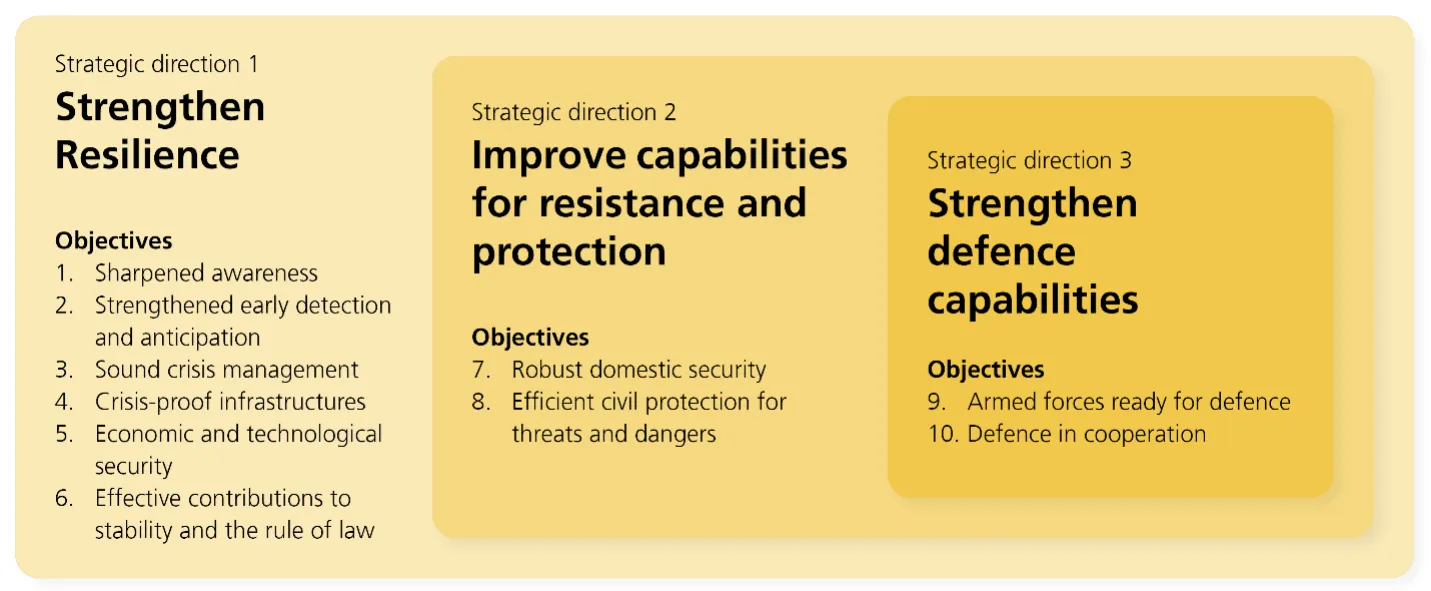
英文原文
Figure 4: The three strategic directions and ten objectives of the security policy strategy 2026.
4.1戰略方向 1:強化韌性Strategic direction 1: Strengthen resilience
原始報告第 30、31 頁
強化瑞士及其人民安全的一個根本做法,是減少所有支撐瑞士穩定與繁榮的系統與功能的脆弱之處,並強化其韌性。瑞士應該為各種威脅與危險做好準備,讓它在事件發生時,能以盡可能少的干擾、成本與損失因應。這個做法是預防性的:即使威脅或危險尚未被視為迫在眉睫,也需要投入心力與資源。它也是防禦性的:減少脆弱之處、強化韌性,能提升我們的安全,卻不會挑釁、更不會威脅任何人。
英文原文
A fundamental approach to strengthening the security of Switzerland and its people is to reduce the vulnerabilities of all systems and functions that contribute to its stability and prosperity and to strengthen its resilience. Switzerland should be prepared for threats and dangers in such a way that it can cope with events with as few disruptions, costs and losses as possible. This approach is preventive: it requires efforts and investments even when a threat or danger is not yet acutely perceived. It is also defensive: reducing vulnerabilities and strengthening resilience improves our security without provoking or even threatening anybody.
強化韌性需要達成以下目標:
英文原文
Strengthening resilience calls for the following objectives:
目標 1:提高警覺
民眾與各機構意識到安全情勢已經惡化。影響力行動與假訊息能被辨識出來,並且無法發揮作用。所有相關行為者與民眾都有高度意願,以一切可用的手段保護與防衛瑞士。
英文原文
Objective 1: Sharpened awareness
The population and institutions are aware of the aggravated security situation. Influence activities and disinformation are recognised as such and ineffective. The willingness to protect and defend Switzerland by all available means is high among all relevant actors and the population.
目標 2:強化早期偵測與前瞻
聯邦及早辨識威脅、危險與安全政策上的機會,預先設想並採取適當措施。這特別適用於混合式衝突的手段,例如影響力行動、網路攻擊,以及政治與經濟施壓。各邦、經濟界與學術界都參與危機的早期偵測。
英文原文
Objective 2: Strengthened early detection and foresight
The Confederation recognises threats, dangers and security policy opportunities in good time; it anticipates and takes appropriate measures. This applies in particular to the means of hybrid conduct of conflict such as influence activities, cyberattacks and political and economic pressure. The cantons, the economy and science are involved in early crisis detection.
目標 3:健全的危機管理
聯邦政府的危機管理具備適當且有彈性的組織與流程,足以處理危機。
英文原文
Objective 3: Sound crisis management
The federal government’s crisis management has appropriate and flexible structures and processes to deal with crises.
目標 4:能承受危機的基礎設施
關鍵基礎設施能抵禦干擾與攻擊。即使在困難的條件下、功能受限時,它們仍能為社會提供必要的服務。對網路攻擊的防護程度高。資訊安全程度高,讓政府機關在危機時能迅速、審慎且有針對性地行動與溝通。
英文原文
Objective 4: Crisis-proof infrastructures
Critical infrastructures are resilient to disruptions and attacks. They provide essential services for society even under difficult conditions and with limited functionality. The protection against cyberattacks is high. Information security is high so that the authorities can act and communicate quickly, judiciously and purposefully in the event of a crisis.
目標 5:經濟與技術安全
取得關鍵商品、服務與技術的管道,以及與安全相關產業的出口機會,都獲得確保。對必要商品與服務的依賴已經減少,供應安全獲得保障。經濟界與學術界受到保護,免於遭到濫用。
英文原文
Objective 5: Economic and technological security
Access to critical goods, services and technologies as well as the export opportunities of the security-relevant industry are secured. Dependencies with regard to essential goods and services are reduced; supply security is guaranteed. The economy and science are protected from abuse.
目標 6:對穩定與法治的有效貢獻
瑞士透過加強與歐盟、北約及雙邊夥伴的合作,促進歐洲安全。20瑞士也為世界其他地區的安全與穩定做出貢獻。它致力於和平與公正的國際秩序,以及多邊機構的行動能力,並推動國際法、人權與國際人道法。
英文原文
Objective 6: Effective contributions to stability and the rule of law
Switzerland promotes European security through increased cooperation with the EU, NATO and bilateral partners.20 It also contributes to security and stability in other regions of the world. It is committed to a peaceful and just international order and the ability of multilateral institutions to act. It fosters international law, human rights and international humanitarian law.
註腳
-
See also Foreign Policy Strategy 2024-2027, Objective 4.
4.2戰略方向 2:提升抵抗與保護能力Strategic direction 2: Improve capabilities for resistance and protection
原始報告第 31 頁
安全不只需要減少脆弱之處,也需要保護與積極的抵抗。有效且可信的保護與抵抗能力,會影響意圖傷害瑞士的行為者的盤算,並讓施壓行動與混合式攻擊無法得逞。
英文原文
Security requires not only the reduction of vulnerabilities, but also protection and active resistance. Effective and credible abilities to protect and to resist influence the calculations of actors who want to harm Switzerland, and they prevent the success of pressure campaigns and hybrid attacks.
要擊退武裝攻擊、恐怖主義、暴力極端主義、間諜、網路攻擊、擴散活動、來自空域或發生在空域中的干擾、影響力行動與組織犯罪,需要穩固的民用與軍事態勢。這包括情報單位、網路防衛、出口管制、偵查與執法機關、警察、海關、邊境安全及移民機關。軍隊必須能夠有效支援民政機關。民眾保護必須更緊密地著眼於擊退與因應混合式衝突,以及為武裝衝突做準備。
英文原文
Repelling armed attacks, terrorism, violent extremism, espionage, cyberattacks, proliferation activities, disturbances in and from the airspace, influence activities and organised crime requires a robust civilian and military posture. This includes the intelligence services, cyber defence, export controls, investigative and law enforcement authorities, police, customs, border security and migration authorities. The armed forces must be able to provide effective support to the civilian authorities. Civil protection must be geared more closely to repelling and coping with hybrid conduct of conflict and preparing for armed conflict.
提升保護與抵抗能力需要達成以下目標:
英文原文
Improving the capabilities for protection and resistance calls for the following objectives:
目標 7:穩固的國內安全
瑞士對抗其境內網路攻擊、間諜、恐怖主義、暴力極端主義、擴散活動及各種形式犯罪的工具都很穩固,並持續調整。瑞士能察覺組織犯罪的活動並加以遏制。政府機關、經濟界、學術界與社會都受到保護,免於遭外國情報單位與組織犯罪滲透。
英文原文
Objective 7: Robust domestic security
Switzerland’s instruments against cyberattacks, espionage, terrorism, violent extremism, proliferation activities and all forms of crime on its territory are robust and are constantly being adapted. Switzerland detects the activities of organised crime and curbs them. Authorities, the economy, science and society are protected from infiltration by foreign intelligence services and organised crime.
目標 8:有效率地保護民眾免受威脅與危險
由民防、警察、消防、醫療衛生與技術單位組成的整合民眾保護體系,能夠預防並處理技術、社會與自然災害,以及健康風險,其中也包括氣候變遷的影響。民眾保護已為混合式衝突與武裝衝突做好準備,並建立或擴充必要的能力。民防的人力與裝備充足。
英文原文
Objective 8: Efficient civil protection for threats and dangers
The integrated civil protection system – consisting of civil defence, police, fire brigades, health care and technical facilities – is able to prevent and manage technological, social and natural hazards as well as health risks. This includes the effects of climate change. Civil protection is prepared for hybrid conduct of conflict and armed conflict and builds up or expands the necessary capabilities. Civil defence is sufficiently staffed and equipped.
4.3戰略方向 3:強化防衛能力Strategic direction 3: Strengthen defence capabilities
原始報告第 32、33、34 頁
鑑於安全情勢日益惡化,軍隊必須更強烈地重新聚焦於防衛,並在人員與裝備上獲得強化。為此,指揮架構也要調整,民用與軍事單位之間為抵禦混合式攻擊及進行防衛所需的合作也要改善。
英文原文
In view of the worsening security situation, the armed forces must be refocused more strongly on defence and strengthened in terms of personnel and equipment. To this end, the command structures are also to be adapted, and cooperation between civilian and military agencies for warding off hybrid attacks and for defence is to be improved.
為了盡可能具備獨立的防衛能力,充分的預先準備絕對必要。瑞士一旦遭受攻擊,中立法上的義務就不再適用。特別是當對手實力壓倒性地強大,或使用遠程武器時,獨立防衛並不有效,甚至可能毫無希望,因此瑞士必須能夠與夥伴共同防衛。鑑於威脅情勢升高,必須及早為這個選項創造條件,因為共同防衛無法臨時拼湊。不過,相關準備不得產生義務與依賴,而且前提是夥伴接受這種做法。
英文原文
Adequate precautions for the best possible independent defence capability are absolutely necessary. In the event of an attack on Switzerland, the obligations under neutrality law do no longer apply. In particular if an opponent is overpowering or uses long-range weapons, an independent defence is not effective, and may even be hopeless, which is why Switzerland must be able to defend itself together with partners. In view of the intensified threat situation, it is necessary to create the conditions for this option in good time, as a common defence cannot be improvised. However, preparations must be made without creating obligations and dependencies and presupposes that the partners accept this.
強化防衛能力需要達成以下目標:
英文原文
Strengthening the defence capabilities calls for the following objectives:
目標 9:具備防衛整備的軍隊
軍隊的裝備、訓練與人力都充足且可持續,使其能夠形成可信的嚇阻效果(「dissuasion」),並能盡可能長時間獨立防衛瑞士。軍隊利用國際合作提升防衛能力,也為夥伴提供訓練及與任務相關的貢獻。
英文原文
Objective 9: Armed forces ready for defence
The armed forces are equipped, trained and adequately and sustainably staffed so that they contribute to a credible deterrence effect (“dissuasion”) and are able to defend Switzerland independently for as long as possible. They utilise international cooperation to increase their defence capability, and they provide training and mission-related benefits to their partners.
目標 10:合作防衛
瑞士在遭受武裝攻擊時,有能力與夥伴共同防衛自己。
英文原文
Objective 10: Defence in cooperation
Switzerland is in a position to defend itself together with partners in the event of an armed attack.
對合作防衛而言,互通性——也就是共同作業的能力——是必須發展並取得的核心前提。互通性來自部隊發展、訓練、裝備、系統與流程上的標準,以及在演習與行動中的合作。互通性在指揮、情報交換、同一區域內的聯合行動(例如空域防護與特種作戰)、網路防衛與後勤方面尤其重要。歐洲的軍事標準主要由北約訂定。瑞士軍隊多年來持續擴展互通性,已在多個領域達到穩固的合作能力,特別是空軍、特種部隊與網路指揮部。軍隊的其他部分也必須持續改善互通性。
英文原文
For defence in cooperation, interoperability – the ability to work together – is a central prerequisite that must be developed and acquired. It is achieved through force development, standards in training, equipment, systems and processes, and cooperation in exercises and operations. Interoperability is particularly important in command, intelligence exchange, joint operations in the same area (such as airspace protection and special operations), cyber defence and logistics. Military standards in Europe are predominantly defined by NATO. The Swiss armed forces have been expanding their interoperability for years and have achieved a solid level of cooperation capability in various areas, in particular in the air force, the special forces and the cyber command. The other parts of the armed forces must also continue to improve their interoperability.
判斷武裝攻擊的依據
衝突進行方式的改變,以及國家、社會與經濟的脆弱性,正使緊張升高與武裝衝突之間的界線變得模糊。儘管如此,政治當局仍必須判斷針對瑞士的特定行動是否構成武裝攻擊。這項認定決定了瑞士在自身的軍事防衛上,能與其他國家或組織合作到什麼程度:如果瑞士遭受武裝攻擊,中立法就不再適用。
英文原文
Reference points for armed attack
The change in the way conflicts are carried out, and the vulnerability of state, society and the economy are blurring the line between increased tensions and armed conflict. The political authorities must nevertheless assess whether certain actions against Switzerland constitute an armed attack. This finding determines to what extent Switzerland can cooperate with other states or organisations for its own militarily defence: If there is an armed attack against Switzerland, the law of neutrality does no longer apply.
習慣國際法已發展出解釋「武裝攻擊」一詞的標準。然而,要套用到具體個案,就需要判斷依據。21對手可以用軍隊全面且公開地發動攻擊、動用軍事武力來達成目標,例如地面攻擊或以遠程武器攻擊。但對手也可以改為、或在此之前先行破壞對國家治理運作、經濟活動與社會生活至關重要的基礎設施。為此,對手可以運用各種混合式衝突的手段,從網路攻擊到由特種作戰部隊執行的破壞行動。
英文原文
Customary international law has developed criteria for the interpretation of the term “armed attack”. However, reference points are necessary for the application to a specific case.21 An adversary can achieve its goals by attacking comprehensively and openly with armed forces and using military force, such as a terrestrial attack or an attack with long-range weapons. Alternatively, however, or in the run-up to it, it can also impair infrastructures that are central to the functioning of state governance, economic processes and social life. In doing so, the adversary can use various means of hybrid conduct of conflict, from cyberattacks to sabotage actions with special operation forces.
聯邦委員會在《2016 年安全政策報告》22中指出,在符合國際法要求的前提下,如果出現針對領土完整、全體人民或國家權力行使的具體、持續、遍及全國且強烈的威脅,而且只能以軍事手段反制,就構成武裝攻擊,軍隊即可投入防衛。
英文原文
In the Security Policy Report 201622, the Federal Council stated, subject to the requirements of international law, that there is an armed attack and that the armed forces can be used for defence if there is a concrete, sustained, nationwide and intensive threat directed against territorial integrity, the entire population or the exercise of state authority that can only be counteracted by military means.
自 2016 年以來,威脅與危險、技術條件,以及國家與社會的脆弱性都已大幅改變。為了反映情勢的變化,需要更新判斷是否發生武裝攻擊的依據。如今的重點,與其說是威脅在時間與空間上的範圍,不如說是損害的程度。由於系統與關鍵基礎設施在數位上相互連結,即使是空間與時間上有限的攻擊,也可能造成巨大損害。
英文原文
Since 2016, the threats and dangers as well as the technological conditions and the vulnerabilities of state and society have changed considerably. To reflect the changed circumstances, updated reference points are needed to understand if an armed attack has occurred. The focus is now less on the temporal and spatial extent of the threat than on the extent of the damage. Due to the digital interconnectedness of systems and critical infrastructures, even spatially and temporally limited attacks can cause great damage.
鑑於攻擊的可能方式越來越多樣,和平與衝突之間也越來越難區分,僵硬或精確的標準仍然沒有幫助。較合適的是具體的跡象,協助政府機關解讀是否已發生武裝攻擊。這些跡象是:
- 已經發生全面、公開的攻擊,或
- 這樣的攻擊迫在眉睫,或
- 已經發生多起協同策劃的攻擊(例如針對國家與社會關鍵功能的多起網路攻擊或破壞行動)。
英文原文
In view of the increasingly diverse possibilities of attack and the reduced ability to distinguish between peace and conflict, rigid or exact criteria are still not useful. More appropriate are concrete indications that help the authorities to interpret whether an armed attack has occurred. These are:
- A comprehensive, open attack has taken place, or
- such an attack is imminent, or
- several jointly orchestrated attacks have taken place (e.g. several cyberattacks or sabotage actions against critical functions of state and society).
這次攻擊或多次攻擊的總和,必須導致瑞士蒙受相當大的物質與人員損害、主權受到重大損害、領土完整遭到侵犯、必要服務無法再提供,或國家、經濟或社會無法再充分運作。判斷時必須考慮到,攻擊手段可以迅速投入使用。
英文原文
The attack or the sum of the attacks must result in Switzerland suffering considerable material and human damage, its sovereignty being significantly impaired, its territorial integrity being violated, essential services no longer being able to be provided or the state, the economy or the society no longer functioning adequately. The assessment must consider that the means of attack can be employed rapidly.
如果瑞士的鄰國正遭受某個行為者的武裝攻擊,而同一個行為者也對瑞士發動混合式攻擊,這就是已發生武裝攻擊的另一項跡象。
英文原文
If countries neighbouring Switzerland are suffering an armed attack by the same actor that carries out hybrid attacks on Switzerland, this is a further indication that an armed attack has taken place.
無論如何,考量並認定瑞士是否已遭受武裝攻擊,以及決定採取哪些措施,都需要審慎而迅速地評估情勢,而且這是一項政治決定。
英文原文
In any case, the consideration and determination of whether there has been an armed attack against Switzerland, and the decision on what measures to take, require a careful, but also rapid assessment of the circumstances, and are a political decision.
註腳
-
依國際法的實踐與判例,如果武力的使用規模相對較大、嚴重程度足夠,並且對目標國家的重要組成部分(例如其人民或與安全相關的基礎設施)造成重大影響,就可以認定為武裝攻擊。聯合國大會關於侵略定義的決議(UNGA Res 3314)特別可用來判斷哪些行為可能構成武裝攻擊。依該決議,例如武裝部隊入侵或轟炸外國領土,都是侵略行為的典型案例,在強度很高時可以視為武裝攻擊。大量較小的暴力行為,加總起來也可以視為武裝攻擊。侵略行為或武力的使用,不一定要以動能或機械手段或武器進行。
英文原文
According to international law practice and case law, an armed attack can be assumed if the force is used on a relatively large scale, is of sufficient severity and has a significant impact on essential elements of the target state, such as its population or security-relevant infrastructures. The United Nations General Assembly resolution on the definition of aggression (UNGA Res 3314) serves in particular to determine which actions can constitute an armed attack. According to this resolution, for example, the invasion of armed forces or the bombing of foreign territory are classic cases of an act of aggression that can, at high intensity, be considered an armed attack. A large number of smaller acts of violence can in total also be considered an armed attack. An act of aggression or the use of force does not necessarily have to be carried out by kinetic or mechanical means or by weapons.
-
Sicherheitspolitischer Bericht der Schweiz 2016; BBl 2016 7763.