原始報告第 11、12、13、14、15、16 頁
世界變得更危險
數十年來,瑞士免於捲入大國權力鬥爭,並受惠於大致穩定的環境。這種情況已經改變。俄羅斯對烏克蘭的戰爭是安全政策上的分水嶺,瑞士也直接感受到它的影響。瑞士的安全如今面臨的威脅,比過去數十年來更大、更多樣,安全政策承受的壓力也相應升高。安全政策的目的,是維護一個自由、獨立且安全的瑞士,並促進和平與公正的國際秩序。1歐洲的這個分水嶺顯示,瑞士若要保護其領土、人民、價值與利益,就必須投資於自身的安全。
英文原文
The world has become more dangerous
For decades, Switzerland was spared major power struggles and benefited from a largely stable environment. That has changed. Russia’s war against Ukraine marks a watershed moment in security policy, the effects of which Switzerland is also feeling directly. Switzerland’s security is facing greater and more diverse threats today than it has seen for decades. Correspondingly, the pressure on security policy is high. Security policy aims to preserve a free, independent, and secure Switzerland and to promote a peaceful and just international order.1 The watershed moment in Europe shows that if Switzerland wants to protect its territory, its population, its values, and its interests, it must invest in its security.
戰爭再度降臨歐洲
多項重大發展正在改變瑞士的安全政策環境。俄羅斯對烏克蘭的戰爭,激烈程度是歐洲自第二次世界大戰以來所未見,也顯示了武裝衝突可能如何演變。此外,混合式衝突也在增加,例如透過假訊息、網路攻擊與破壞行動。經濟與關鍵基礎設施的相互連結,以及技術發展,都加深了依賴;而利用這些依賴從事強權政治的意願也已升高。因此,民用與軍事手段緊密交織,內部安全與外部安全也是如此。與危機和衝突之間的地理距離,正變得越來越不重要。
英文原文
War again in Europe
Various developments for great importance are changing Switzerland’s security policy environment. Russia’s war against Ukraine is being waged with an intensity that Europe has not experienced since the Second World War. It shows how armed conflicts can develop. In addition, the hybrid conduct of conflict is increasing, for example by means of disinformation, cyberattacks and acts of sabotage. The interconnectedness of the economy and of critical infrastructures as well as technological development increase dependencies. The willingness to use such dependencies for power politics has increased. Civilian and military means are therefore closely intertwined, as are internal and external security. The geographical distance to crises and conflicts is becoming less important.
國際關係(包括經濟領域)受到強權政治更強烈的影響。國際法遭到質疑,甚至被公然違反。越來越多國家以武力威脅或動用武力,追求自身的利益與野心。大國公開談論以軍事手段奪取領土,或威脅使用核武。一些威權國家在政治、經濟與軍事上的合作日益緊密。
英文原文
International relations, including in the economic sphere, are more strongly influenced by power politics. International law is questioned or even broken. More and more states are threatening or using force to pursue their interests and ambitions. Great powers speak publicly about using military means to conquer territories or threaten to use nuclear weapons. Some autocratic states are working increasingly closely together politically, economically and militarily.
最後,民主國家也承受來自內部的壓力:極化與使用暴力的意願都已升高,部分原因也來自外部的影響。恐怖主義與暴力極端主義仍是持續存在的威脅。組織犯罪活動大幅增加。氣候變遷的後果越來越明顯,例如以天然災害的形式出現;此外還有與技術及社會相關的風險,武漢肺炎(Covid-19)疫情就是一例。
英文原文
Finally, democracies are also coming under pressure from within: polarisation and a willingness to use violence have increased – in part also due to external influence. Terrorism and violent extremism remain persistent threats. Organised crime activities have increased considerably. The consequences of climate change are becoming more visible, for example in the form of natural disasters; as well as technology- and society-related risks, as the Covid-19 pandemic showed.
俄羅斯越來越常以破壞行動與侵犯領空進行挑釁。自新一屆政府於 2025 年上任以來,美國的安全與外交政策持續轉變,必須預期美國及其軍隊在歐洲的投入會減少。因此,北約、歐盟及其多數成員國都致力於強化歐洲獨立的防衛能力。
英文原文
Russia is increasingly provoking with sabotage actions and airspace violations. The United States’ security and foreign policy have been changing since the new administration took office in 2025. A reduction of the commitment of the US and its armed forces in Europe must be expected. NATO, the European Union and most of their member states are therefore committed to strengthening Europe’s independent defence capability.
在可預見的未來,瑞士不太可能遭受全面、武裝且直接的攻擊——這也要歸功於北約與歐洲的防衛及安全努力。然而,這類攻擊也可能以長程武器進行。無人機、彈道導引飛彈、巡弋飛彈與極音速武器的射程與精準度不斷提高,預警時間則持續縮短。情勢可能迅速改變,但防衛所需的手段卻需要多年準備。
英文原文
A comprehensive, armed and direct attack on Switzerland is unlikely in the foreseeable future – also thanks to the defence and security efforts of NATO and Europe. However, such an attack can also be carried out with long-range weapons. The ranges and precision of drones, ballistic guided missiles, cruise missiles and hypersonic weapons are increasing, while the warning times are decreasing. The situation can change rapidly, yet the required means for defence require many years of preparation.
無論如何,在歐洲鄰近地區爆發軍事衝突並直接波及瑞士的風險,已大幅升高。隨著俄羅斯攻擊烏克蘭、主張其在東歐的勢力範圍,以及美國安全保證的不確定性,俄羅斯與北約發生對抗的可能性已經增加。
英文原文
In any case, the risk of a military conflict in the closer European vicinity with direct consequences for Switzerland has increased considerably. With Russia’s attack on Ukraine, its claim to a sphere of influence in Eastern Europe and uncertainty regarding the United States’ security guarantees, the likelihood of a confrontation between Russia and NATO has increased.
這些發展是本瑞士安全政策戰略的出發點。特定情境發生的機率難以判定——尤其是近年已顯示情勢非常不穩定。安全政策戰略必須持續以情勢升級為前提,並據此調整預防措施。由於瑞士的安全體系目前在抵抗混合式攻擊與防衛兩方面都準備不足,這件事更顯急迫。鑑於周遭環境的發展,歐洲與全球情勢可能改變到必須從根本檢討瑞士安全與國防政策的程度。
英文原文
These developments are the starting point for the present security policy strategy for Switzerland. The probability of certain scenarios is difficult to determine – especially since the situation is very volatile, as recent years have shown. A security policy strategy must continue to assume an escalating situation and align its precautions accordingly. This is more urgent given that Switzerland’s security apparatus is currently insufficiently prepared for resisting hybrid attacks as well as for defence. In view of the developments in the surrounding environment, the European and global situation could change in such a way that a fundamental review of Switzerland’s security and defence policy might become necessary.
全面安全
瑞士同時面對內部與外部的威脅——無論來自國家行為者、恐怖團體或激進化的個人,形式是假訊息與破壞活動,還是軍事武力。因此需要全面的安全政策回應,這也是本戰略採取全面安全取向的原因。
英文原文
Comprehensive security
Switzerland is confronted with a simultaneity of internal and external threats – whether from state actors, terrorist groups or radicalised individuals, disinformation and sabotage or military force. Therefore, a comprehensive security policy response is needed. That is why this strategy follows the approach of comprehensive security.
全面安全是指以整體的方式形塑安全政策。它包含民用與軍事的手段及行為者,並在規劃與安排中納入外交、內政與經濟政策中所有和安全政策相關的面向。當所有相關行為者在共同戰略的框架下合作,就能達成全面安全。這需要各級政府——聯邦、各邦與市鎮——以及社會各個領域,也就是政界、企業、科學界與公民社會共同參與。
英文原文
Comprehensive security describes the approach of shaping security policy holistically. It includes civilian and military means and actors, and it includes all aspects of foreign, domestic and economic policy relevant to security policy in its planning and arrangements. Comprehensive security is achieved when all relevant actors work together within the framework of a common strategy. This requires involving all government levels – federal, cantonal and municipal – as well as all areas of society, namely politics, business, science and civil society.
冷戰期間形塑瑞士安全政策的是過去的總體防衛;與之不同,全面安全也包含國際合作,因為多數威脅都是跨國的。這種全面的做法不只適用於可能發生的武裝衝突,也必須抵禦當前的威脅,並為未來的威脅做好準備。這種結合各方力量的努力,讓瑞士有能力抵抗、擊退攻擊並自我防衛。
英文原文
In contrast to the former total defence, which shaped Switzerland’s security policy during the Cold War, comprehensive security also includes international cooperation, because most threats are transnational. This comprehensive approach must not only be applied in potential armed conflict; it must ward off current threats and serve to prepare for future threats. This combined effort makes Switzerland capable of resisting, repelling attacks and defending itself.
瑞士周遭環境的發展與其內部組織,既需要、也使全面的做法成為可能。由於瑞士的聯邦結構,安全有賴國家、公民社會與私部門行為者之間,聯邦、各邦與市鎮之間,以及民間與軍事組織之間的緊密合作,也有賴全體民眾的參與。瑞士的安全政策可以動用各種手段:從情報、網路防禦、警察與邊境安全,到軍隊與民眾保護,再到外交政策與國家經濟供應等經濟措施。
英文原文
The development in Switzerland’s environment and its internal organisation require and enable a comprehensive approach. Due to its federal structure, security depends on close cooperation between state, civil society and private actors, between the Confederation, cantons and municipalities, civilian and military organisations and the involvement of the entire population. Switzerland’s security policy can draw on various means, from intelligence, cyber defence, police and border security to the armed forces and civil protection to foreign policy and economic measures such as national economic supply.
為此,瑞士必須與鄰國及夥伴合作。例如,保護民眾免受技術或自然災害、打擊恐怖主義與犯罪,若能跨越國界進行,並讓瑞士既能受惠於他國的能力、又能發展自身的能力,成效就會更大。最後,面對武裝攻擊需要強大的防衛,無論是獨立防衛還是合作防衛。
英文原文
To this end, Switzerland must cooperate with its neighbours and partners. For example, the protection of the population against technical or natural hazards is greater and the fight against terrorism and crime more effective if they take place across borders and when Switzerland can benefit from the capabilities of others and develop its own. Finally, an armed attack requires a strong defence, both independently and in cooperation.
瑞士安全政策的演變
冷戰結束後,瑞士加強了促進和平的國際努力。和其他歐洲國家一樣,瑞士持續削減軍隊的資源,並把重點放在支援民政機關的輔助性任務上。防衛能力因此降低,民眾保護也不再是優先事項。
英文原文
The development of Swiss security policy
After the end of the Cold War, Switzerland intensified its international efforts to promote peace. Like other European countries, it continuously reduced the armed forces’ resources and focused on subsidiary operations for civilian authorities. The defence capability was reduced, and civil protection was no longer a priority.
然而,聯邦委員會早在《1993 年中立報告》中就已指出,瑞士自主防衛能力有其極限。特別是在防空領域,並考量到技術變遷,瑞士可能不得不讓其安全與國防政策更著重於與他國合作。該報告主張,在一定限度內,這種合作符合中立的意義與精神——尤其是中立國有義務採取軍事預防措施,才能成功抵禦攻擊。2
英文原文
However, the Federal Council had already pointed out the limits of Switzerland’s autonomous defence capability in the 1993 Neutrality Report. Especially in the field of air defence and in view of technological changes, Switzerland could be compelled to focus its security and defence policy more strongly on cooperation with other countries. The report argued that such cooperation, within certain limits, is compatible with the sense and spirit of neutrality – all the more so since a neutral state is obliged to take military precautions to successfully defend himself against attacks.2
《2000 年安全政策報告》3為這個方向提供了概念基礎,並指出安全政策工具之間與各級政府之間的國內合作,應以更多的國際合作加以補充。特別是瑞士加強了警察合作,並成為申根區的聯繫會員國。《2010 年安全政策報告》4也強調了內部安全面臨的挑戰。
英文原文
The Security Policy Report 20003 conceptually underpinned this orientation and stated that domestic cooperation between security policy instruments and levels of government should be supplemented by increased international cooperation. In particular, Switzerland strengthened police cooperation and became an associate member of the Schengen area. The Security Policy Report 20104 also emphasised the challenges of internal security.
由於歐洲安全情勢給人惡化的印象,特別是自 2014 年俄羅斯併吞克里米亞以來,聯邦委員會在 2016 年把瑞士安全政策5的重心更多地轉向強權政治帶來的威脅。《2021 年安全政策報告》6特別探討了混合式衝突。2022 年 2 月俄羅斯公然以軍事攻擊烏克蘭,促使瑞士加強防衛努力並深化國際合作。這是 2022 年 9 月《2021 年安全政策報告》補充報告7的結論。該報告重申,瑞士作為中立國,打算盡可能獨立地自我防衛;同時也要創造條件,以便在遭受武裝攻擊時,必要時能與他國共同防衛。
英文原文
Following the impression of a deterioration in the security situation in Europe, especially since the annexation of Crimea by Russia in 2014, the Federal Council in 2016 refocused Switzerland’s security policy5 more strongly on threats by power politics. The Security Policy Report 20216 particularly dealt with the hybrid conduct of conflict. Russia’s open military attack on Ukraine in February 2022 prompted Switzerland to step up defence efforts and intensify international cooperation. This was the conclusion of the supplementary report to the Security Policy Report 2021 of September 20227. It reaffirmed Switzerland’s intention to defend itself as independently as possible as a neutral state, while at the same time to create the conditions to be able to do so jointly with other states, if necessary, in the event of an armed attack.
2023 年夏天,聯邦國防、民防暨體育部因應這些發展,設立了一個研究委員會,目的是從外部觀點並以廣泛的專業知識,為本安全政策戰略提供推動力。2024 年 8 月,委員會提出研究報告8,包含 100 多項建議,其中有調整中立政策、與外國夥伴進行深入的防衛合作、在 2030 年前把國防預算提高到國內生產毛額的 1%,以及其他強化社會與經濟韌性的措施。其中許多想法已納入本戰略;其他則仍在討論中,或已因政治決定而遭否決。
英文原文
In the summer of 2023, the Federal Department of Defence, Civil Protection and Sport set up a study commission in response to these developments. It was intended to provide impetus for the present security policy strategy from an outside perspective and with broad expertise. In August 2024, the Commission presented its study report8 with over 100 recommendations, including adjustments to the neutrality policy, far-reaching defence cooperation with foreign partners, an increase of the defence budget to 1% of the gross domestic product by 2030, and other measures to strengthen social and economic resilience. Many of these considerations have been incorporated into this strategy; others are the subject of ongoing debates or have been rejected by political decisions.
《2026 年瑞士安全政策戰略》的定位
《2026 年瑞士安全政策戰略》以這些基礎為依據,並考量新的發展。秉持全面安全的精神,本戰略著重於強化韌性、提升抵抗與保護能力,以及增強防衛能力:這三個戰略方向對應了情勢的惡化。這些戰略方向共包含十項目標,並為達成目標訂定了 45 項具體措施。
英文原文
The status of Switzerland’s Security Policy Strategy 2026
Switzerland’s Security Policy Strategy 2026 is based on these foundations and takes into account new developments. In the spirit of comprehensive security, it focuses on strengthening resilience, resistance and protection, and increasing defence capability: three strategic directions that correspond to the worsening of the situation. These strategic directions contain a total of ten objectives, for the achievement of which 45 concrete measures have been formulated.
《2026 年安全政策戰略》是聯邦與各邦機關執行安全政策、調配各自資源的框架。本戰略的對象是聯邦、各邦與市鎮,以及來自社會、經濟、科學與政治的利害關係人,讓他們都能為落實本戰略做出貢獻。此外,本戰略也作為國外夥伴的參考方向。
英文原文
The security policy strategy 2026 serves as a framework for the national and cantonal authorities to implement security policy and to organise their respective resources. The strategy is aimed at the Confederation, cantons and municipalities as well as stakeholders from society, the economy, science and politics, so that these can contribute to the implementation of the strategy. In addition, it serves as an orientation for partners abroad.
因此,《2026 年安全政策戰略》是涵蓋所有安全政策相關領域的上位戰略。它與《2024–2027 年外交政策戰略》9及《對外經濟政策戰略》10相互協調。相關的主題性或部門性子戰略、計畫與報告,都位階在這些戰略之下。
英文原文
The security policy strategy 2026 thus represents the umbrella strategy that addresses all areas relevant to security policy. It is aligned with the Foreign Policy Strategy 2024-20279 and the Foreign Economic Policy Strategy10. Related thematic or sectoral sub-strategies, plans and reports are subordinate to these strategies.
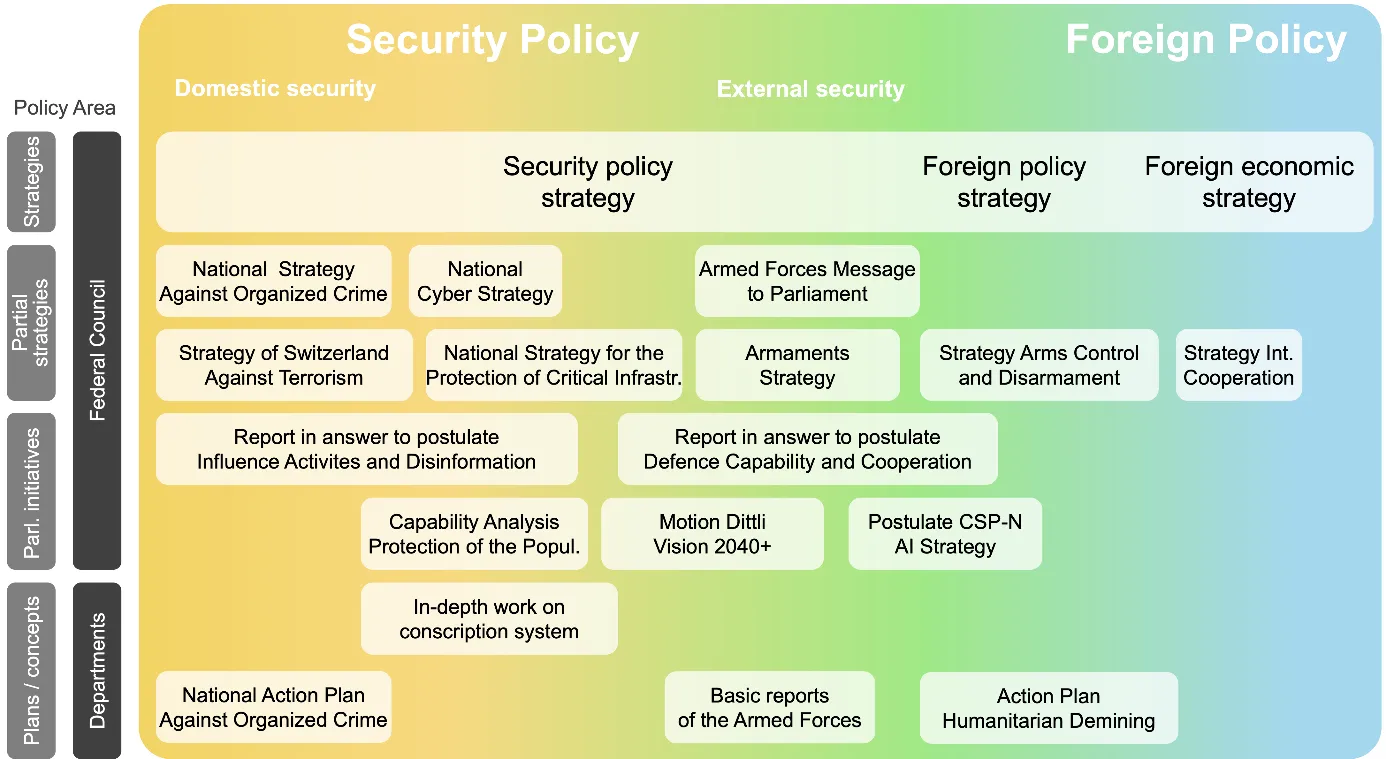
英文原文
Figure 2: Conceptual order of strategies and reports (non-exhaustive presentation).
這些戰略的落實需要整體的統籌指導與持續追蹤進度。DDPS(聯邦國防、民防暨體育部)將會同安全政策國務秘書處負責此事。
英文原文
Their implementation requires overarching steering and continuous monitoring of progress. The DDPS is to ensure this with the State Secretariat for Security Policy.
聯邦委員會通過本戰略,也回應了國會的多項提案:
- 國民院議員 Rechsteiner 提出的動議(Motion)22.3726,要求制定安全與防衛的上位戰略,特別是針對不同行為者與政策領域之間的互動與協調;
- Gredig 提出的審查請求(Postulate)22.3308,要求聯邦委員會檢視瑞士參與歐洲及國際計畫與合作項目的情形並提出報告;
- Z’graggen 提出的動議 24.4036,要求在戰略中提出強化社會、經濟與軍事韌性及防衛能力的具體措施;
- Roth 提出的審查請求 25.3264,要求聯邦委員會提出措施,以降低瑞士在安全上對美國的依賴,並加強在安全政策領域與歐洲國家及歐盟的合作。
英文原文
With the adoption of the strategy, the Federal Council is responding to several parliamentary initiatives:
- Motion 22.3726 by National Councillor Rechsteiner, which calls for an overarching strategy on security and defence, in particular on the interaction and coordination between the various actors and policy areas;
- Postulate 22.3308 Gredig, according to which the Federal Council should examine and report on Switzerland’s participation in European and international programmes and cooperation projects;
- Motion 24.4036 Z’graggen, which calls for concrete measures for social, economic and military resilience and defence capability in a strategy;
- Postulate 25.3264 Roth, according to which the Federal Council should set out the measures to reduce Switzerland’s security dependence on the United States and strengthen cooperation with European states and the European Union in the field of security policy.
當情勢變化有此需要時,本安全政策戰略將定期檢討並重新提出。落實情形報告將於 2028 年底前提交聯邦委員會。
英文原文
The security policy strategy will regularly be reviewed and resubmitted if changes in the situation suggest it. A report on the status of implementation will be submitted to the Federal Council by the end of 2028.
註腳
-
According to Art. 2 Cst; SR 101.
-
Bericht über die Aussenpolitik der Schweiz (Report on the Foreign Policy of Switzerland); BBl 1994 I 153, pp. 222 et seqq.
-
Bericht über die Sicherheitspolitik der Schweiz 2000; BBl 1999 7657.
-
Bericht über die Sicherheitspolitik der Schweiz 2010; BBl 2010 5133.
-
Sicherheitspolitischer Bericht der Schweiz 2016; BBl 2016 7763.
-
Sicherheitspolitischer Bericht der Schweiz 2021; BBl 2021 2895.
-
Zusatzbericht zum Sicherheitspolitischen Bericht 2021; BBl 2022 2357.
-
Bericht der Studienkommission Sicherheit, 29.08.2024 (Report of the Study Commission on Security).
-
Foreign Policy Strategy 2024-2027, 06.05.2024.
-
Foreign Economic Policy Strategy, 24.11.2023.